
Challenges of battled a chronic health issues while working
First of all, maintaining a full-time job while dealing with a chronic illness is not easy. In fact, it can lead to exhaustion as well as frustration. Dealing with the constant symptoms leaves individuals wondering if they are doing more harm to the body than good. Eventually, many will be forced to make some hard decisions, For example, whether to leave your job and focus on your health.
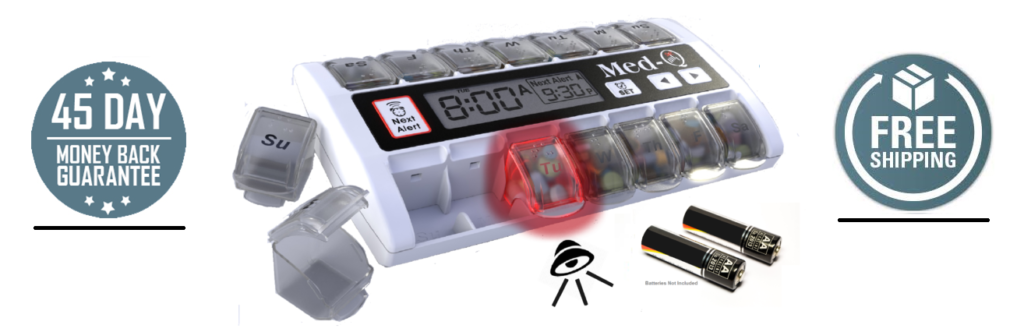
Hence, many men and women’s bodies are not able to do both. To illustrate, many people end up quitting their jobs. Others, will go part-time. However, the loss of wages for many simply isn’t an option. Question, do you need help navigating a full-time job while managing a chronic illness? Med-Q smart Pill reminders with alarms helps you answer this tough question.
8 tips to help strike a balance between working and living with a chronic sickness.
1. First thing to do, disclose your condition to tell your boss as well as co-workers.
- To begin with, some will choose to keep your health conditions private. Here is a useful example, Bart Roberts of Long Grove, IL, was telling coworkers about his decade long battle with interstitial cystitis. Furthermore, telling coworkers about his inflammatory bladder problems were just what he needed. The results, feeling less overwhelmed.
Bart decided to his boss about my illness because he needed the extra mental support. Bart asked colleagues to cover my room when I needed to go to the bathroom. To sum up, having others understand the special needs lowered the level of stress.
2. Use a Smart Programmable pill reminder with alarms and timers
To begin with, it is critical to take medication properly. For example, C. Everett Koop, US Surgeon General, says, “Medication will not work if not taken properly”. There is a plethora of Smart Programmable pill reminder with alarms and timers to make life easier. The cutting edge pill dispensers will have flashing guides and blasting audio alarms. The goal, take the burden off the users and put it onto the newest pill dispenser technology.
Hence, the forgetting and miss dosing problem will virtually disappear. Remember. not taking life saving prescription medication as directed by your health care professional is a matter of life and death. To sum up, battled a chronic health issues while working is made so much easier with a smart Pill reminders with alarms.

3. Know what the company’s Family Medical Leave Act (FMLA) policy
First, go to The Family Leave Act website. Second, look up the your company’s FMLA policy. Third, see if you may qualify for Intermittent Leave. Intermittent Leave. is when work allows you to periodically call in sick. Hence, when you are too ill to work or have a doctor’s appointment, you will not be penalized for missing work.
According to the Employee’s Guide to the Family and Medical Leave Act, you must be employed in order to qualify. Generally, the rule of thumb, employers with more than fifty employees are covered by law. Furthermore, employers with less than fifty workers will not be covered by FMLA. However, many will be covered by state medical leave laws. Med-Q recommends that you speak to Human Resource department.
Requirements
FMLA requires you to have
-
First, Have worked with your current employer for at least for 1 full year (12 months)
-
Second, Have accrued at least 1250 hours of work in the last 1 full year (12 months)
-
Third, the employer has over fifty employees within a 75-mile radius of the jobsite
Obviously, the benefit is a valuable way to ease the worry and stress during periods when you need time to rest and recover. To sum up, one can still keep your job an manage a chronic illness.
4. Write down everything.
Above all, write things down. First, get a journal to write in. The need is great. For example, people with certain chronic illnesses, remembering a long agenda is nearly impossible. The cause, brain fog, fatigue as well as other reasons. To stay organized, try carrying a journal wherever you go. Each morning, make a to-do list of the necessary items needed to tackle that day. Again, be sure to track your mes with a Smart Programmable pill reminder with alarms. Med-Q has found that not everything is important. Hence, know what is a priority (prescription medications) and what is is not.
5. Develop a working relationship with the doctor.
Indeed, having a good doctor-patient relationship with open communication is critical. Again, good communication will be crucial in helping her maintain full-time employment while sick. To begin with, using the health care professional; is the biggest ally and is usually very helpful. As an example, ask the doctor if there ares any treatments that are available to help me function better at work. The Doctor understands the demands working while sick. The goal, find a treatment that will not impair the ability to work. Also remember, if you feel like your doctor isn’t listening to your concerns, don’t be afraid to look for a new doctor.
6. Educate your family and friends about your illness.
For example, Mary Mcdonald lives with chronic Lyme disease. Mary has a high stress job. She is the director of business development, marketing, and contracting for two behavioral health hospitals in Chicago, IL. In addition, to her busy job, Mary is in an aggressive treatment protocol for the disease. Equally important. to be able to handle the job as well as the chronic illness, she tried to educate her family and friends.
Hence, educatieds them about the realities of living and fighting Lyme disease. Mary has suggested that empowering your loved ones with useful information is very helpful. First, take time to provide reading material that is easy for your friends and family to understand., Second, sit down with them to talk it through. Third, answer any questions that you are able to. Again, it is imperative to inform them about the daily struggles. To sum up, many family, friends as well as co workers will want to help you. Finally, so let them!
6. Respect your limits.
Likewise,know your bod. In comparison, pushing the body to the maximum limits is harmful. Again, being smart is vital to the creation of a healthy work-life balance. Clearly, when getting home, to take some time for yourself. If you don;t. even the simplest of tasks can be exhausting. Learning to rest and saying no to other activities will give strength to do the job.
7. Find activities that help to restore your body, mind as well as your spirit
For example, try taking a walk, attending a yoga class as well as social group.. Again, these activities can help to “recharge one’s batteries”. However, the key to it remaining beneficial, is to not over do it. Nevertheless, try to gauge what your body needs are at the time, Tom sum up, find something that works for you to recharge your internal battery. To say nothing of, bringing joy to your life.
8.Make sure you get plenty of sleep
Best-selling author, board-certified internist, and renowned chronic illness expert, Jacob Teitelbaum, MD, recommends getting 8-9 hours of uninterrupted sleep every night. Dr Teitelbaum tells us, :This is needed to replenish your body’s energy reserves”. By the same token, it’s easy to stay up late watching TV. For example, staying up late while checking your social media posts. Above all, these activities has been known to keep people up until the wee hours of the morning. . Instead, try to go to sleep before 11:00 p.m.). Having a good sleep cycle will lead to reduced pain, improved cognition skill, as well as increase in personal energy levels. Finally, all parts must be done to continue doing your job well.
I Have a Job and a Chronic Illness
Without a doubt, it is a monumental task to find the energy to keep a full-time job while dealing with a chronic illness. Hence. Med-Q’s advice, pay specific attention to the signals the body offers. Furthermore, slow down and rest if the body tells you to..
Thus, the lessongthat has to be continually relearn. With some trial and error, hopefully these tips can provide some new tools to support you in your health and work life. If you have your own advice for how to manage work with a chronic illness, please share it with me in the comments!
Finally, a Smart programmable pill reminder with alarms.. What to do when Working and taking medicine? What is the best pill dispenser for Mom? Med-Q Pill Reminder or Smart Pill reminder with Alarms isAmerica’s best Medication Management tool.
[cherry_sharing networks=”facebook,googleplus,pinterest,stumbleupon,reddit,twitter,linkedin,tumblr” style=”only-logos”]