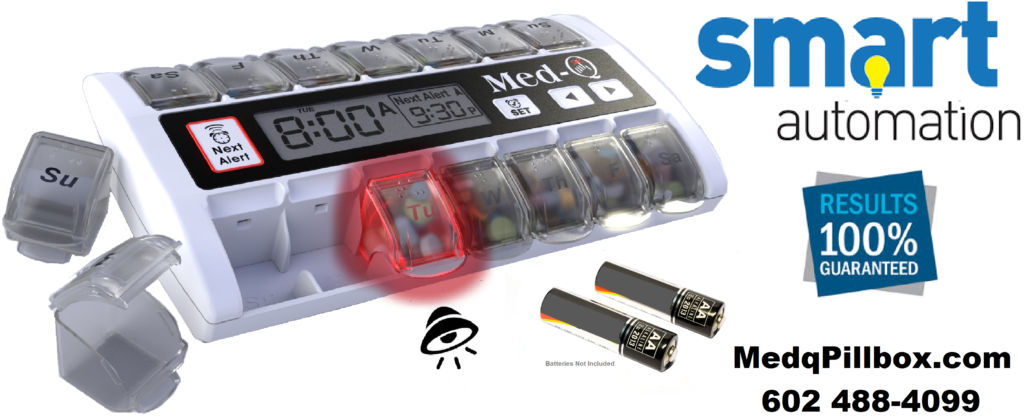
Alzheimer’s Medication problems solved with Smart Programmable pill dispensers with Alarms

Alzheimer’s
Everyone knows, Alzheimer’s makes the medication compliance problem worse. First, the average senior takes between 5 and 8 pills and supplements every day. Second, many are life saving prescription pills. Third, a medication compliance system needs to be in place. Doctors will recommend a smart pill dispenser or programmable pill box. These medication reminders will help ensure that meds are taken at the right time. Finally, the smart pill boxes will ensure the right doses are taken.
Alzheimer’s Clues to Watch For
Alzheimer’s clues in patients. For example, those who suffered significant head injuries before age 65. Hence, it showed symptoms at an earlier age than those who hadn’t had head injuries. Some recommends avoiding contact sports involving your head. In addition, using protective headgear.
Alzheimer’s forgetting medication
Alzheimer’s starts in the hippocampus. In short, it is often called the brain’s seat of memory, Hence, disorientation is a hallmark of the disease. In other words, a people with Alzheimer’s are notorious for wandering off. For example, navigational problems might arise very early in the course of cognitive decline. The National Institutes of Health-funded study that looks at people’s ability to navigate and whether those who are navigation-ally challenged will face faster cognitive decline.
DEMENTIA USES CHANGES IN THE WAY PEOPLE WALK
The inability to simultaneously walk and talk may indicate the onset of Alzheimer’s. “Walking while talking is a divided attention task,” says Verghese. Presumably the long studied gait changes in patients with non-Alzheimer’s dementia. In the early stages of dementia or actually have dementia, then this becomes more challenging . The reason, because you have limited attention resources.
On the other hand many different studies presented at the 2012 Alzheimer’s Association International Conference tied gait change to the dementia. Alzheimer’s correlated with slower and/or erratic walking as well as difficulty in performing such tasks as walking while counting backward.
DEPRESSION AND SOCIAL WITHDRAWAL
People who suffer from depression earlier in life are more likely to develop Alzheimer’s as they age. A study by the Multi-Institutional Research in Alzheimer’s Genetic Epidemiology group, led by Robert Green of Harvard Medical School and published in Archives of Neurology in 2003, found a significant link between Dementia diagnoses and people who had shown symptoms of depression within the past year. No doubt doctors have long noted that people with Alzheimer’s tend to become depressed and withdraw socially, recent studies show that the depression predates dementia.
Sleep disorders such as sleep apnea have been linked to cognitive deficits.
Previous studies found Alzheimer’s plaque developing in mice’s brains when their sleeping schedules were significantly disrupted. A study released in 2012 correlated sleep disruption and Alzheimer’s in humans. The Washington University study, led by David Holtzman of the college’s Department of Neurology, studied 150 cognitively normal people.
Alzheimer’s and Dementia Bio-markers
Those with bio markers for Alzheimer’s, as measured in their spinal fluid, were the worst sleepers. They spent more of their time in bed awake and napped more frequently during the day than those without the Alzheimer’s biomarkers. Accordingly, sleep apnea is also linked tonighttime cardiac events and high blood pressure. Both of these correlate with Alzheimer’s. To sum up, a medication problems solved with smart pill box can help with sleep.
It’s helpful to give your advocate details of your medical history. For example, you may want to discuss the tests you’ve had. Second, list medicines you in the smart pill dispenser. Third, and provide any treatment preferences as well as contact information for other family members and your durable power of attorney.
Granted, there are lots of frustrations and failures
, however that doesn’t mean the science has stood still. Sabbagh recommends making lifestyle changes as a preventative strategy right away. Eat your greens. Exercise. Value your social connections, and use your brain power. “You ought not to wait. For this reason by the time one become symptomatic, the pathology in your brain is significant.”
Medication problems solved with Smart Programmable pill dispensers with Alarms. First, the average senior takes between 5 and 8 pills and supplements every day. Second, many are life saving prescription pills. Third, a medication compliance system needs to be in place. Doctors will recommend a smart pill dispenser or programmable pill box. These medication reminders will help ensure that meds are taken at the right time. Finally, the smart pill boxes will ensure the right doses are taken.
Health care Advocate for the best elderly medication management
Enlisting a doctor or nurse to be your health advocate can be costly, but there are options
You can hire someone from a home health aide company or organization. These advocates work by the hour. Fees range considerably – from as low as $15 an hour (often with a minimum number of hours) to much higher – depending on your needs, where you live and other factors. Some health insurance plans cover these services. Again, problems solved with smart programmable pill box are easy. And some employers provide benefits for this through membership in a patient advocacy company.