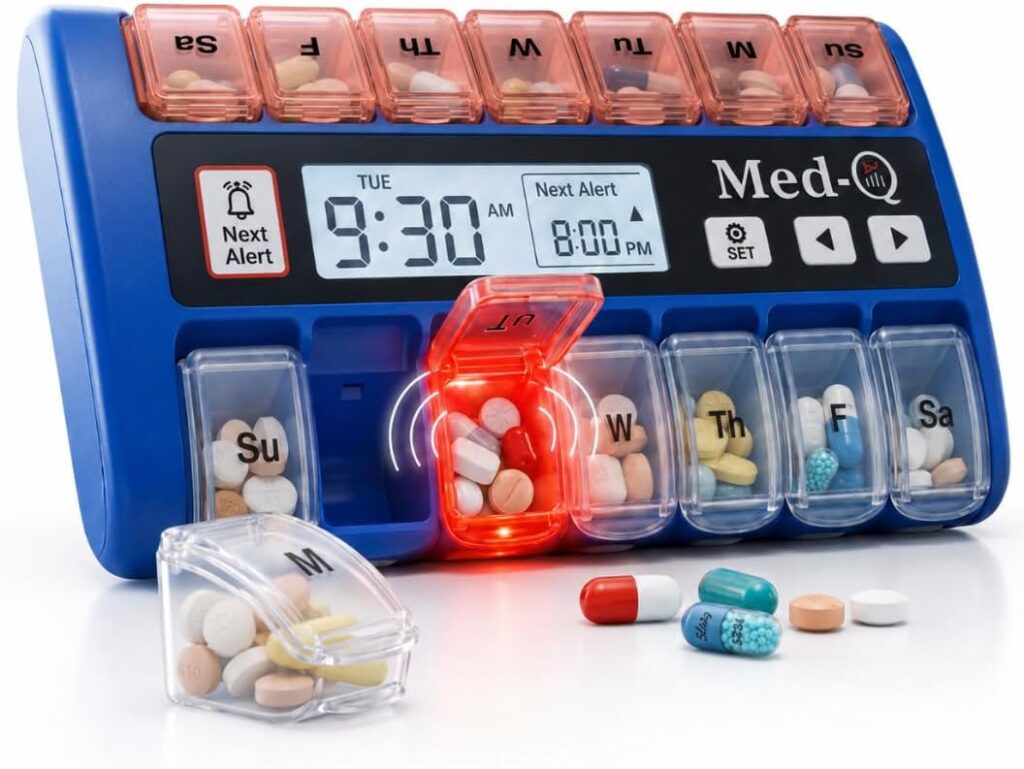
Why is Medication Compliance Important for Seniors?
Managing medications is a daily reality for millions of older adults, and it is often far more complicated than it seems. Many seniors take multiple prescriptions at once, a situation known as polypharmacy, which affects a large portion of the aging population and can increase the risk of side effects, missed doses, and harmful drug interactions. Complex schedules, changing health conditions, and even simple challenges like remembering doses or reading small labels can make medication adherence feel overwhelming.
Yet, while these challenges are common, they are also manageable. Small, practical changes, such as simplifying routines, using reminders, or reviewing medications regularly, can make a meaningful difference. With the right strategies, seniors can take control of their medication routines, improving not only their health outcomes but also their confidence and independence.
Common Barriers to Medication Compliance
Medication adherence remains one of the most persistent challenges in healthcare, directly affecting outcomes, costs, and quality of care. But what are the barriers to medication adherence, and why do so many patients struggle to follow prescribed treatment plans?
In this article, we explore five of the most common barriers to medication adherence — from forgetfulness and complex regimens to socioeconomic and communication factors. We also introduce a remote therapeutic monitoring solution designed to help patients stay on track and improve adherence over time.
What Are the Barriers to Medication Adherence?
Medication adherence is the extent to which patients take medications as prescribed by their healthcare providers. It is a complex issue shaped by many factors. Research consistently shows that adherence rates of 80% or more are generally needed for optimal therapeutic efficacy, yet adherence to chronic medications hovers around 50%.
The consequences are significant. Medication nonadherence can account for up to 50% of treatment failures, roughly 125,000 deaths, and as much as 25% of hospitalizations each year in the United States. The World Health Organization has long emphasized that improving adherence may have a greater effect on population health than any single medical treatment.
Why is Medication Compliance Important for Seniors?
Managing medications is a daily reality for millions of older adults, and it is often far more complicated than it seems. Many seniors take multiple prescriptions at once, a situation known as polypharmacy, which affects a large portion of the aging population and can increase the risk of side effects, missed doses, and harmful drug interactions. Complex schedules, changing health conditions, and even simple challenges like remembering doses or reading small labels can make medication adherence feel overwhelming.
Yet, while these challenges are common, they are also manageable. Small, practical changes, such as simplifying routines, using reminders, or reviewing medications regularly, can make a meaningful difference. With the right strategies, seniors can take control of their medication routines, improving not only their health outcomes but also their confidence and independence.
Strategies to Improve Medication Adherence
The problem is that patients lie about taking their medications for a variety of reasons – they do not care whether they get better, they feel fine, or they don’t want their doctor to be disappointed in them. Instituting the Morisky Medication Adherence Scale3 helped, but we eventually came up with a broader set of questions:
1. Do you have all of the medications you were prescribed? (Probe for barriers such as cost or confusion.)
2. Do you understand why you are taking them?
3. Do you ever forget to take your medications? (Discuss phone alarms, putting pills by the coffeemaker, etc.)
4. Do any of your medications make you sick?
5. If you feel worse, do you stop taking them?
6. If you feel better, do you stop taking them?
7. If you have asthma, do you have a spacer? Do you carry a rescue inhaler (at work, in the car, at school, etc.)?
A nurse or medical assistant asks these questions, along with questions about health confidence, prior to the patient being seen by the provider. We record the answers in our electric health record so we can track adherence over time.
Here are some of the lessons we have learned:
1. Be aware of the tendency to use medical jargon. Instead of saying, “This will treat your hypertension,” say, “Let’s try this for your high blood pressure.”
2. Don’t judge. Instead of saying, “Why aren’t you taking your metformin?” say, “I’m curious to know what happens when you take your metformin.”
3. Be aware of costs. Most patients are hesitant to say they can’t afford a medication, so ask the patient to get back to you if the copayment or cost is too high.
4. Look for underlying conditions. For example, patients who are depressed rarely take their medications, so consider treating the depression first.
5. Be clear about the benefit of the medicine. For example, you might say, “If you take your diabetes medicines and control your blood sugar, you may not need to have your eyeglass prescription changed as often.”
6. Move your patients’ prescriptions to mail order if possible. Going to the pharmacy is often an obstacle.
Medication adherence is key to improving patients’ confidence to manage their illness, improving clinical outcomes, and lowering utilization. Asking the right questions has made a real difference in our practice.