
MED-Q Parkinson’s Disease Pill Timer with alarm prevent Medication Non Compliance
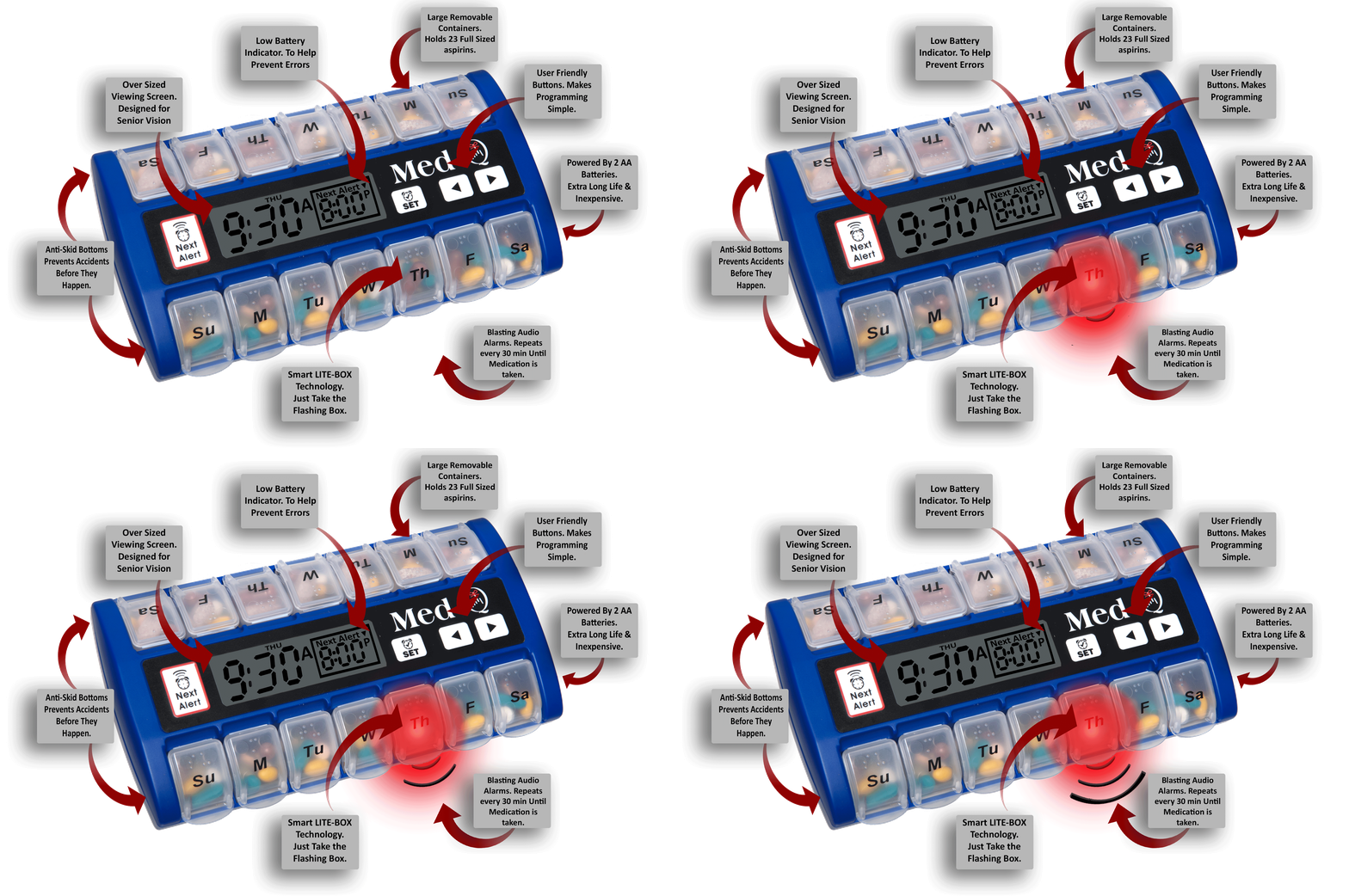
What is the definition of non compliance in Parkinson’s? It is the failure to take medication as prescribed by your health care professional. This is made worse with Parkinson disease.. Hence, the need for a Parkinson’s disease pill timer. The old style pillboxes isn’t proper tool for people with Parkinson. Finally, now is the time to upgrade to an electronic Parkinson’s disease pill timer.
You need a Parkinson’s Disease Pill Timer with alarm

It is not unusual for people suffering with Parkinson’s forget medication.. First, the problem will get worse as-the illness progresses. Second, seniors suffer from AIMM (Age Induced Medication Mistakes). The Center for Disease Control has issued many studies about the the effects of medication errors on Parkinson’s suffers. That is why they need an Parkinson’s Disease Pill Timer with alarm to help prevent Non Compliance.
However there is much more than just non adherence.. First of all, non compliance is also indicative of the disease. Here are some pointers, like a Parkinson’s Disease Pill Timer with alarm prevent Medication Non Compliance.
- The Potential of Negative Side Effects. Prescriptions don’t zero in on their Parkinson’s. Furthermore, they would lead to the best outcomes. In brief, it’s just not that easy. Negative side effects can occur as a unintended consequence from medication errors.

Treatment for Parkinsons
As of the date of this article, Parkinson’s disease can’t be cured. However, there is good news. There is cutting edge medications that help to control symptoms. In many cases, very dramatically. Hence, MED-Q Parkinson’s Disease Pill Timer with alarm helps ensure the best outcomes.To sum up, Medication Non Compliance makes these new regiments ineffective.
The Newest kinds of Medications
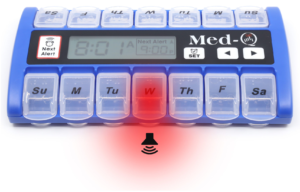
Medications may help many sufferers. These prescriptions can help to manage problems. For example, walking, other movements as well as the tremors. These medications increase the missing dopamine. Forgetting or miss dosing can be extremely bad. Hence, the need for the MED-Q Parkinson’s Disease Pill Timer with alarm.
Parkinson’s disease is caused by low brain dopamine concentrations. However, dopamine can’t be directly injected into the brain. However, many have shown great improvement after Parkinson’s disease treatment. However, benefits of drugs will diminish or become less consistent over time. Finally, many still can control some symptoms reasonably well.
The Newest Medications that are being prescribed include:
-
Carbidopa-levodopa. Levodopa, a top medication. this is a natural chemical that will then pass into the brain. Once inside, it is converted to dopamine.
Levodopa is combined with carbidopa (Lodosyn). The results, protects levodopa from too early of a conversion into dopamine on the outside of the brain. To sum up, the combo tends to lessen negative side effects. For example, nausea and other stomach issues. Other Side effects, dizziness as well as lightheadedness (orthostatic hypotension). Benefits from levodopa usually will become less stable. In addition, they have a tendency to wearing off.
Also, some have experienced some kinds of involuntary movements (dyskinesia). This coincidence with taking higher doses of levodopa. The health care professional may lessen your dose or adjust the times of your doses to control these effects. Hence, another example of the importance of a Parkinson’s Disease Pill Timer with alarm to have Medication Compliance.
-
Carbidopa-levodopa infusion. Duopa is a brand-name medication. Its compnents, carbidopa as well as a mix of levodopa. This is given through a feeding tube direct into the stomach. It delivers the medication in a gel form into the intestines. Duopa is for advance patients. They must still respond to carbidopa-levodopa. Placement of the tube requires a small surgical procedure. Risks associated with having the tube include the tube falling out or infections at the infusion site.
-
Dopamine agonists. Dopamine agonists mimic dopamine effects in the brain.
They have not been shown to be as effective as levodopa in in certain symptoms. However, they will last for a longer period of time. In addition, can be with levodopa, which smooth the off-and-on effect of taking doses of levodopa. Some of the side effects of dopamine agonists are similar to the side effects of carbidopa-levodopa. But they can also include hallucinations, sleepiness and compulsive behaviors such as hypersexuality, gambling and eating. If you’re taking these medications and you behave in a way that’s out of character for you, talk to your doctor.
-
MAO B inhibitors. These medications include selegiline (Eldepryl, Zelapar), rasagiline (Azilect) and safinamide (Xadago). They
 will aid in the beraeking down of brain dopamine. Ghis is done by inhibiting the brain enzyme monoamine oxidase B (MAO B). This enzyme metabolizes brain dopamine. Side effects may include nausea or insomnia. A elevated risk of hallucinations if added to carbidopa-levodopa.
These medications are not often used in combination with most antidepressants or certain narcotics due to potentially serious but rare reactions. Check with your doctor before taking any additional medications with an MAO B inhibitor.
-
Catechol O-methyltransferase (COMT) inhibitors. This pill will mildly prolong the effect of levodopa therapy by blocking a specific enzyme. Some of the negative side effects include: elevated chances of involuntary movements and having bouts of diarrhea.
-
Anticholinergics. These are used to help control the tremors that come with Parkinson’s disease. For example, benztropine or trihexyphenidyl. Finally, benefits are not offset by negative side effects. To illustrate, impaired memory, confusion. In addition, bouts of hallucinations, experiencing constipation and dry mouth.
-
Amantadine. Doctors may prescribe amantadine alone to provide short-term relief of symptoms of mild, early-stage Parkinson’s disease. It may also be given with carbidopa-levodopa therapy during the later stages of Parkinson’s disease to control involuntary movements (dyskinesia) induced by carbidopa-levodopa. The negative side effects include purple mottling of the skin and having hallucinations.
How you are able to help with medication costs
 First, place to start is by picking the best of insurance company. Second, find out about the range of prescription benefits offered. Third, make certain that the pills they’re taking are covered. This is particularly important if they’re several medications in their smart pill reminder with alarms.
The prescriptions bought via internet can save money.
In particularly in larger quantities, offers handsome savings in many instances. Client should be made aware that purchasing medication via internet pharmacies is a dicey proposition. However provide no physical address or phone number and are possibly fronts for nefarious drug activity.
Hence, Parkinson’s Disease Pill Timer with alarm for Forgetfulness. Again. Forgetting to take medication is a typical cause of non compliance. In fact, men and women forget to take medication from time to time. However chronic forgetfulness is made worse for people with Parkinson’s. Hence, associated with cognitive decline.
To sum up, an old fashion pill boxes will not be the proper tool for compliance.